
Top 9 Enterprise Imaging Platforms for Zero-Footprint Diagnostic Viewing
Radiology teams lose hours each week moving DICOM studies between hospital servers, outside imaging centers, and remote specialists. Slow transfers and inconsistent viewers push many departments to search for a single zero-footprint solution that works across locations. Medicai's platform is one option on their list.
By the end of this article you will know the nine concrete features to compare, see how Medicai ranks against eight other platforms, and have a short checklist that shows which system fits your workflow before you schedule any demos.
What to Look For in Enterprise Imaging Platforms for Zero-Footprint Diagnostic Viewing
Enterprise imaging platforms require specific capabilities to deliver reliable zero-footprint diagnostic viewing across multiple clinical environments.
Organizations need to evaluate several technical requirements when selecting systems that support diagnostic imaging workflows. These requirements ensure the platform meets clinical standards for image quality and performance.
- DICOM conformance classes supported, including Storage, Query/Retrieve, and Print services
- Bandwidth requirements for 3D reconstruction with 2-second latency under typical network conditions
- Hanging protocol storage limits per user for consistent viewing preferences across sessions
- HL7 FHIR resource compatibility for patient demographics and study metadata exchange
- Multi-monitor calibration standards that maintain consistent display characteristics
- Annotation audit trail retention periods meeting regulatory compliance requirements
- Cross-enterprise document sharing (XDS-I) support for external facility access
- Mobile device screen size thresholds that maintain diagnostic accuracy standards
- Lossless compression ratios for CT/MR studies without image degradation
- RIS worklist synchronization intervals for real-time study availability updates
Each requirement addresses different aspects of clinical workflow and regulatory compliance. Technical teams should verify these specifications against institutional needs before implementation.
Platform selection directly impacts diagnostic accuracy and workflow efficiency. Meeting these technical requirements helps ensure consistent performance across various clinical scenarios.
1. Medicai - Best Overall
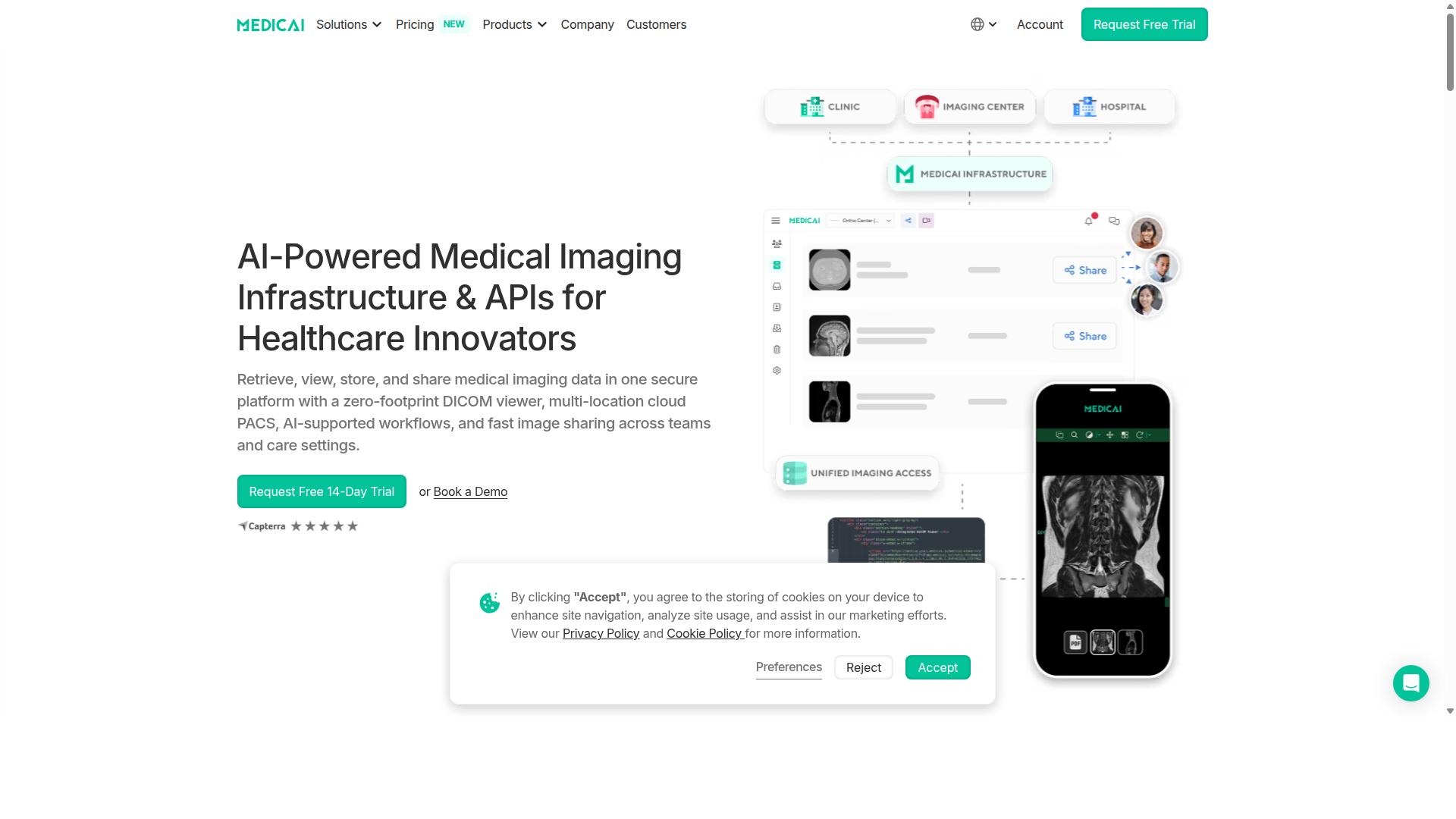
Medicai provides a complete cloud imaging solution that addresses enterprise requirements for secure, zero-footprint diagnostic viewing.
The platform operates entirely through a web browser without any local software installation. This architecture supports radiologists and specialists who need immediate access to studies across multiple facilities.
Healthcare teams retrieve imaging data from various sources through the secure cloud infrastructure. Studies load quickly in the browser interface while maintaining diagnostic quality standards.
Storage functions include a cloud PACS and vendor neutral archive that centralize image management. The system handles multiple modalities and maintains HIPAA compliance for all stored data.
Sharing workflows allow authorized users to exchange studies with referring physicians and external care teams. Patient case management tools organize imaging data for coordinated care delivery.
Key Features and Pricing
Medicai's feature set combines extensive storage capacity with unlimited user access and flexible connectivity options.
The Starter plan provides 500 GB of cloud storage for $249 per month. This tier includes unlimited user accounts and serves organizations without connected locations.
The Standard plan expands to 2 TB of storage for $749 per month. This level adds one connected location for DICOM gateway integration.
Enterprise pricing uses custom configurations for storage requirements and supports multiple connected locations plus external access points. Yearly billing offers 15% savings on both Starter and Standard tiers.
The Medical Imaging Uploader enables secure study transfer from various sources. The DICOM Gateway connects on-premise systems to the cloud platform.
Cloud PACS functionality provides the core viewing and storage infrastructure. Medical Image Exchange facilitates secure study sharing between care teams.
Patient Case Management organizes studies for clinical workflows. The Vendor Neutral Archive ensures data portability across different systems.
Backup and Disaster Recovery capabilities maintain data integrity and availability. A 14-day trial allows evaluation of Starter plan features without upfront commitment.
2. Intelerad

First sentence: Intelerad offers enterprise-grade imaging solutions with established market presence in hospital networks.
The platform delivers core PACS functionality through a cloud-hosted architecture designed for secure medical image exchange across healthcare organizations. Enterprise imaging workflows benefit from distributed access that supports diagnostic review without local installations.
Integration capabilities focus on compliant image sharing between facilities that need to exchange studies efficiently. The system accommodates multi-modality support while maintaining data protection standards required in clinical environments.
Deployment models emphasize cloud-hosted infrastructure that scales with organizational needs. Providers can access the zero-footprint viewer through standard web browsers, eliminating the requirement for dedicated workstation hardware at each location.
Additional technical features include load balancing mechanisms and session management protocols that maintain reliability during high-volume access periods. The architecture supports cross-enterprise access patterns common in referral networks and teleradiology arrangements.
3. ProtonPACS
ProtonPACS provides cloud-based imaging services targeted at smaller healthcare facilities and specialty practices. Organizations deploy cloud PACS through hosted environments that eliminate local server maintenance while preserving full access to diagnostic tools.
Deployment models typically include fully managed cloud hosting, hybrid configurations that keep some data on premises, and vendor-neutral archive setups that consolidate images from multiple sources. Each approach reduces hardware costs and simplifies long-term data storage.
Basic workflow automation covers study routing that directs incoming exams to appropriate radiologists, automated worklist updates, and simple hanging protocols that arrange images consistently across reads. These features help standardize processes without requiring extensive configuration.
Multi-modality support spans MRI, CT, x-ray, and ultrasound studies, while RIS integration and EMR connectivity allow patient data to travel alongside images. Web-based viewers enable access from standard browsers, supporting teleradiology and remote consultations from any location.
Security protocols follow HIPAA compliance standards to protect patient information during storage and transmission. Interoperability standards such as DICOM and HL7 facilitate connections between imaging systems, radiology workstations, and existing clinical software across the enterprise.
4. Sectra
Sectra delivers enterprise imaging solutions with focus on large healthcare systems and academic medical centers. The platform includes PACS, VNA, and UniView components designed for multi-modality support across radiology, cardiology, and pathology departments.
Enterprise scalability features allow healthcare organizations to expand imaging capabilities without replacing existing infrastructure. The system supports multiple sites through centralized administration while maintaining individual facility workflows and preferences.
Multi-site deployment capabilities include image exchange portals that facilitate cross-enterprise access between hospitals and clinics. Organizations can share studies securely while preserving diagnostic quality through controlled compression and transmission protocols.
The platform integrates AI tools for assisted diagnosis and 3D planning capabilities that enhance clinical decision making. Healthcare systems benefit from unified reporting functions that connect imaging data across departments and specialties.
More than 2,500 sites worldwide rely on Sectra systems for their imaging needs. The solution supports cloud deployment options through Sectra One Cloud for organizations seeking reduced on-premise hardware requirements.
5. PostDICOM
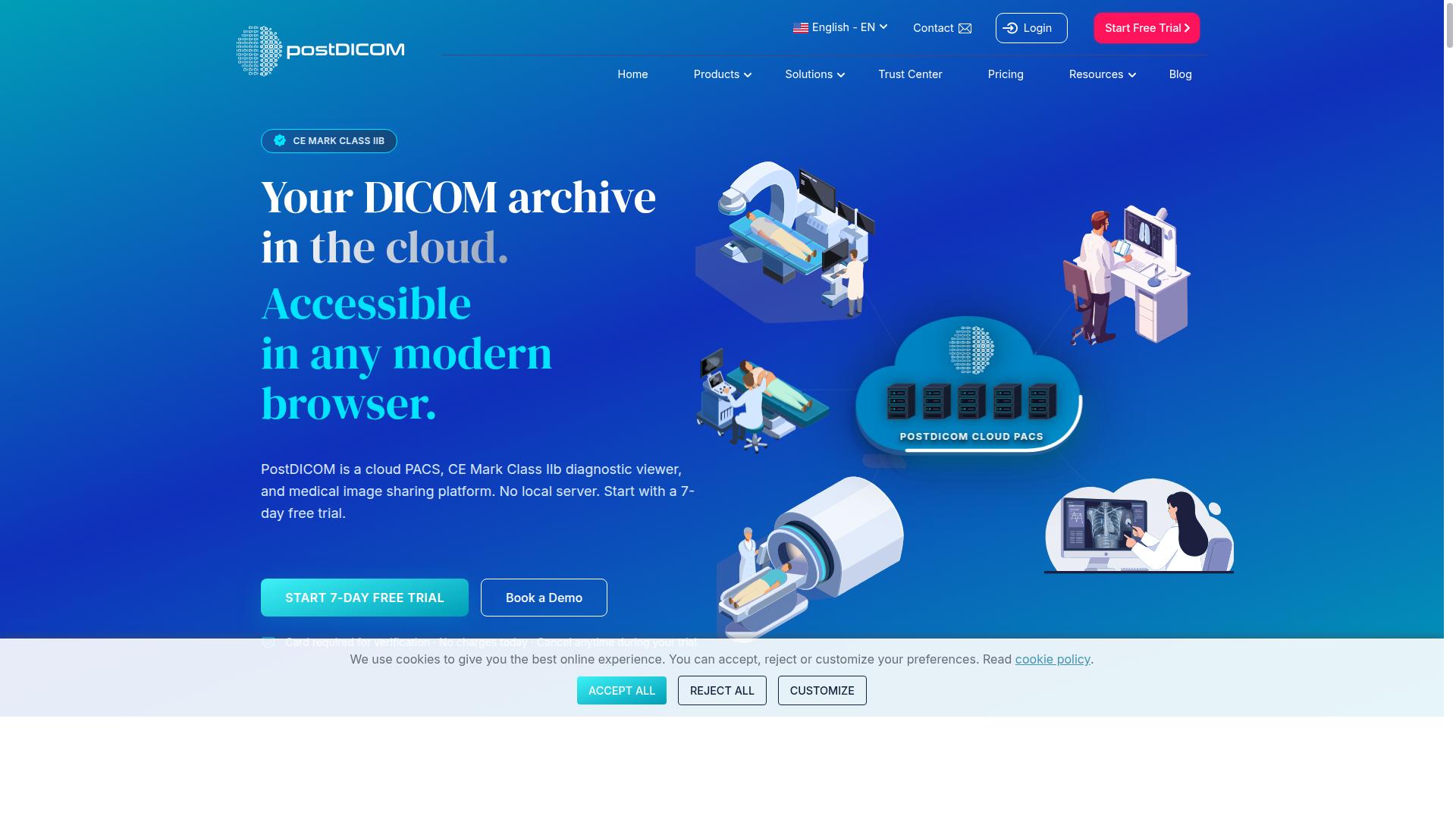
PostDICOM offers web-based DICOM viewing with emphasis on accessibility and ease of deployment. The platform functions as a cloud PACS solution that eliminates the need for local servers while supporting diagnostic imaging workflows across multiple specialties.
Users can access medical imaging data through a zero-footprint HTML5 viewer that includes advanced features such as multiplanar reconstruction and 3D rendering capabilities. The system supports measurement tools and MIP processing for detailed study analysis without requiring additional software installation.
PostDICOM enables secure data sharing through password-protected links that maintain compliance with HIPAA and GDPR requirements. The platform stores information across 12 Microsoft Azure regions, providing geographic flexibility for organizations with distributed healthcare networks.
Integration capabilities extend through the Medical Device Communicator, which connects imaging modalities directly to the cloud system. This approach supports various clinical workflows including teleradiology, dental imaging, orthopedics, and veterinary applications.
The platform includes teaching library tools that facilitate educational use cases alongside standard diagnostic functions. Organizations can trial the system for seven days before committing to a full implementation.
6. PaxeraHealth
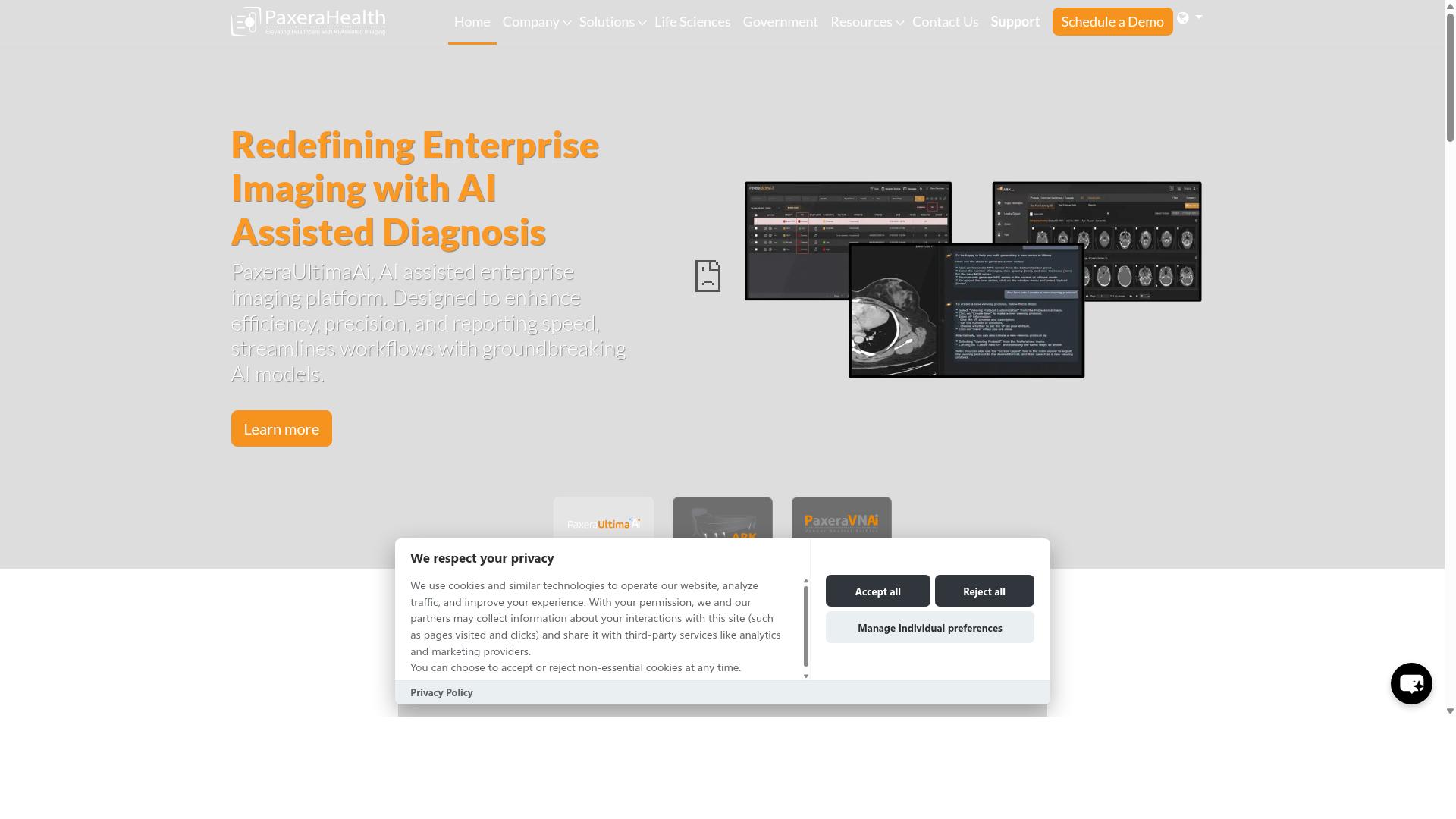
PaxeraHealth provides imaging solutions designed for diagnostic workflows across multiple specialties.
The platform supports multi-modality imaging and delivers core PACS capabilities. Hospitals and radiology groups use these tools to manage studies from different modalities within a single interface.
Basic PACS functions include study routing, image storage, and retrieval. These features allow facilities to move studies efficiently between departments without additional hardware on clinician workstations.
Users access images through web browsers, which supports zero-footprint diagnostic viewing. This approach reduces the need for local software installation and simplifies deployment across enterprise networks.
The system works with existing hospital infrastructure. Integration with RIS and EMR systems helps maintain consistent patient records and supports daily clinical operations.
7. Sirona Medical

Sirona Medical focuses on cloud-native imaging platforms with integrated workflow tools. The system delivers enterprise imaging capabilities through a zero-footprint viewer that eliminates local installation requirements. Healthcare organizations can access diagnostic imaging across multiple departments without managing on-site hardware infrastructure.
Cloud architecture provides several operational benefits for medical facilities. Remote access becomes possible from any location with internet connectivity, supporting distributed radiology teams and teleradiology workflows. Data storage moves to secure cloud environments that handle backup and maintenance centrally.
Workflow integration approaches focus on connecting with existing hospital information systems. The platform supports DICOM standards for image exchange and can interface with radiology information systems through established protocols. Staff members can maintain familiar processes while gaining access to cloud-based study routing and image archive features.
Multi-modality support allows radiologists to view CT, MRI, ultrasound, and X-ray studies within the same interface. The zero-footprint viewer handles different image formats automatically without requiring specialized workstation software. This capability proves useful for facilities managing diverse imaging equipment from multiple vendors.
Security measures include HIPAA compliance protocols and encrypted data transmission between users and the cloud platform. Organizations gain cross-enterprise access capabilities that allow authorized clinicians to review studies from different locations while maintaining audit trails for regulatory requirements.
8. Fujifilm
Fujifilm provides comprehensive imaging solutions spanning hardware and software ecosystems.
Their enterprise imaging portfolio includes the Synapse Enterprise Imaging platform. This cloud-hosted system supports multiple clinical specialties through a unified patient view.
Synapse Enterprise PACS serves as the core component for diagnostic viewing. The platform incorporates a vendor-neutral archive to consolidate imaging data from various sources across healthcare networks.
Integration capabilities extend to several workflow management tools. The Synapse AI Orchestrator connects multiple artificial intelligence applications while the Synapse Worklist Orchestrator distributes imaging studies across available radiologists.
Additional components include three-dimensional reconstruction tools and mobile access features. These elements address different aspects of medical image management while maintaining compatibility with existing hospital systems.
The portfolio also encompasses analytics modules and cloud services. These additions help healthcare organizations manage imaging operations across both hospital and outpatient settings through Synapse One solutions.
9. Exa PACS
Exa PACS delivers diagnostic imaging solutions with focus on workflow efficiency and system interoperability. The platform combines PACS and RIS functions into one integrated database. This unified structure helps reduce duplicate entries and simplifies study management across different departments.
The system includes a zero-footprint viewer that runs in standard web browsers without requiring software downloads. Server-side rendering supports access from various connection speeds while keeping image data secure on the server. This approach eliminates the need to store protected health information on local workstations.
Exa PACS supports multiple clinical specialties through specialized versions for teleradiology, mammography, cardiology, and orthopedics. Each version maintains the same core diagnostic imaging capabilities while adding tools tailored to specific reading workflows. The platform also includes billing functions that connect directly to the imaging workflow.
Integration features allow connection with existing EMR connectivity systems through standard HL7 interfaces. The single database design supports study routing between different locations and user groups. This architecture helps organizations maintain consistent access to patient imaging records across their enterprise.
How to Choose the Right Option
Selection criteria should align platform capabilities with specific organizational imaging volumes and clinical workflow requirements. Healthcare providers need to evaluate each enterprise imaging solution against measurable operational demands rather than general feature lists.
Annual study volume capacity requirements determine whether a platform can handle current and projected imaging loads. Organizations should calculate peak daily volumes across all modalities and account for seasonal fluctuations in diagnostic imaging demand.
Multi-site connectivity needs become critical when radiology workflows span multiple facilities or involve teleradiology services. Cross-enterprise access requires robust network architecture and study routing capabilities that maintain diagnostic quality across locations.
Specialty-specific tool requirements vary significantly between orthopedics, cardiology, oncology, and other clinical areas. Measurement tools, hanging protocols, and 3D reconstruction features must match the diagnostic needs of each medical specialty served.
Integration timeline with existing EMR/RIS systems affects implementation speed and clinical workflow disruption. HL7 FHIR compatibility and RIS integration determine how quickly a zero-footprint viewer can connect with current medical image management infrastructure.
Data residency and compliance specifications address HIPAA compliance requirements and regional data storage mandates. Organizations must verify that any cloud PACS or vendor-neutral archive meets their specific regulatory obligations for patient data protection.
Total cost of ownership modeling for 3-year projections should include licensing, implementation, training, and ongoing support expenses. Scalability considerations affect long-term costs as imaging volumes grow and additional sites come online.
Final Verdict
Platform selection ultimately depends on matching technical capabilities with organizational scale and clinical requirements. Enterprise imaging demands vary significantly across healthcare systems, radiology groups, and specialty clinics.
Organizations processing substantial imaging volumes benefit from platforms that demonstrate proven scale through real-world deployment. 1M+ studies processed annually and 1.7M+ studies in storage indicate capacity to handle high-throughput environments without performance degradation.
Zero-footprint diagnostic viewing requires robust visualization infrastructure. 300k+ DICOM visualizations completed in the last year demonstrate consistent delivery of web-based diagnostic display capabilities across multi-modality studies.
Integration demands in modern healthcare settings extend beyond basic PACS functionality. 50M+ yearly API transactions reflect extensive interoperability with existing EMR systems, RIS platforms, and third-party applications through standards-based connectivity.
Compliance remains non-negotiable for clinical imaging deployments. HIPAA and GDPR compliance combined with FDA/CEE cleared viewers ensures regulatory readiness across different jurisdictions and care settings.
Security frameworks matter particularly for cloud-based medical image management. Following OWASP security guidelines provides documented protection standards for sensitive patient data transmitted through web-based diagnostic viewers.
Network effects emerge when platforms accumulate substantial user bases. 70 clinics and hospitals currently using the system with 10,000+ active doctors suggest established adoption patterns and peer validation.
Scale metrics reveal platform maturity. 2M+ imaging studies uploaded to date indicates sustained growth and operational reliability across diverse institutional settings.
Clinical efficiency gains differentiate platforms in competitive evaluations. Reducing diagnosis time by 65% addresses concrete workflow bottlenecks that impact patient throughput and radiologist productivity.
Cloud infrastructure partnerships provide additional operational assurance. The Microsoft Azure partnership delivers enterprise-grade hosting, redundancy, and compliance capabilities expected in large-scale medical imaging deployments.
Real-world applications demonstrate platform versatility. Press coverage highlights successful implementations in global multidisciplinary tumor boards and support for Ukrainian refugee patients accessing cancer treatments, confirming cross-enterprise collaboration capabilities.