
How to Buy the Glow Peptide Stack for Research: A 2026 Buyer's Guide
A Glow Peptide Stack purchase for your lab should not start with a checkout button. Batch testing, COA verification, and storage documentation decide whether your research holds up, and 2026 catalogs make those details easier to miss than ever.
This guide walks you through what the Glow Peptide Stack contains, how to read purity and batch-testing records before you pay, and what Kovagen publishes at the batch level. You will finish with a clear checklist for pricing, shipping to U.S. and Canadian labs, and an honest call on whether this stack fits your study.
What Is Kovagen (KOVA)? Who the Glow Peptide Stack Is For
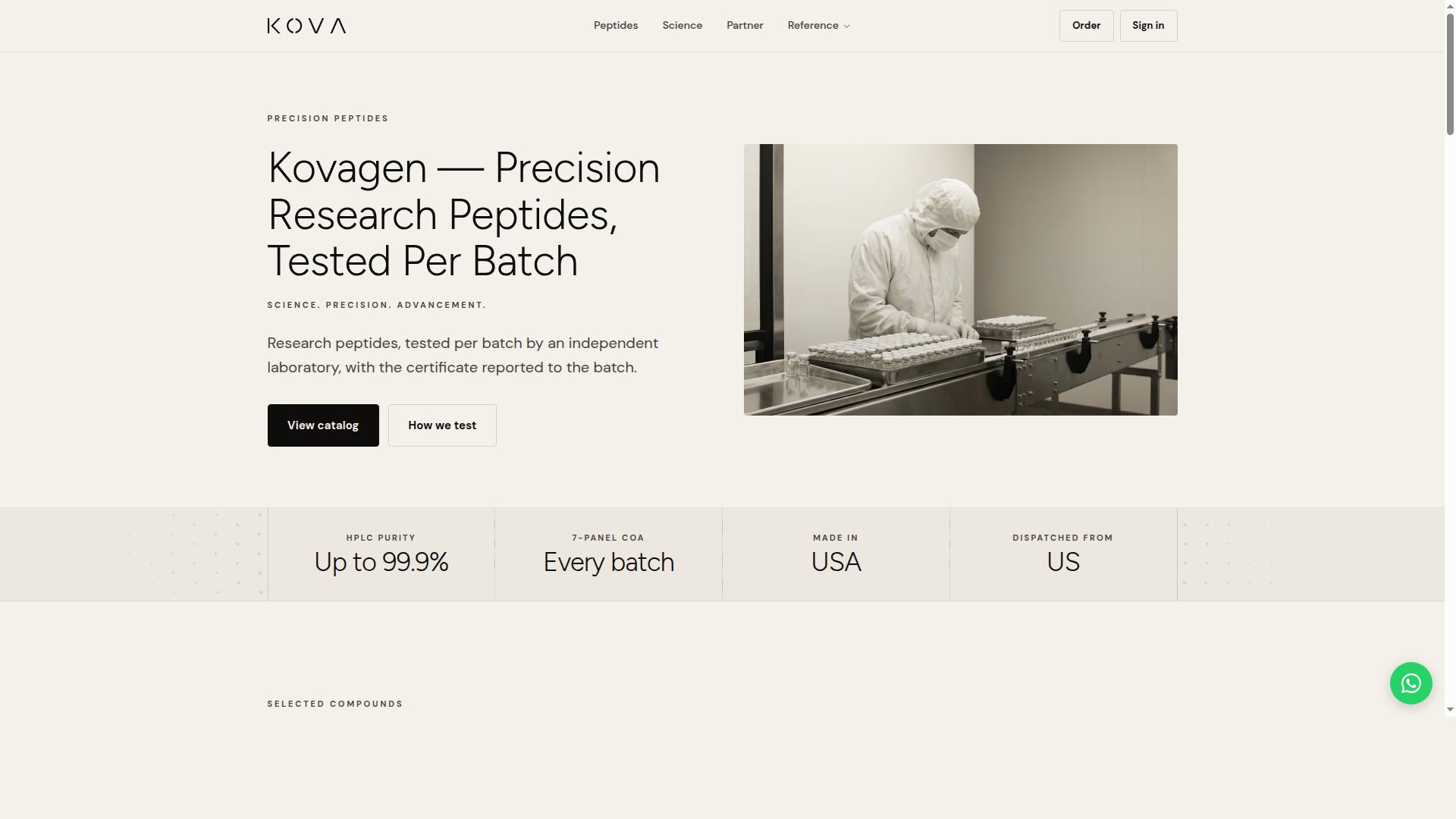
Kovagen (KOVA) is a research peptide supplier that sells lyophilized peptides, including the Glow Peptide Stack, to laboratory researchers in the United States and Canada, with every batch tested by an independent analytical laboratory. The brand positions itself around a simple idea, captured in its stated motto: Science. Precision. Advancement.
That motto reflects how KOVA treats evidence as the product itself. Rather than asking buyers to take purity claims on faith, the brand ties testing documentation to each individual batch. For anyone navigating peptide procurement in 2026, that distinction matters more than ever.
Kovagen operates as an e-commerce store, supplying research peptides and research supplies. Its catalog is built around lyophilized peptides, the freeze-dried format that researchers reconstitute in the lab before use. Shipping is limited to the United States and Canada.
Every batch is tested by an independent analytical laboratory, and certificates are tied to each batch rather than issued generically. In practical terms, that supports COA verification: a researcher can match the documentation to the specific lot in hand. For techniques like HPLC testing and mass spectrometry, batch-level documentation is the difference between a verifiable material and an anonymous vial.
The Glow Peptide Stack is supplied strictly for laboratory research use only. It is not for human or veterinary consumption, and it is not a therapeutic, cosmetic, or dietary product. Its intended context is in vitro studies and preclinical research, where controlled conditions and documented materials are the norm.
That framing defines the audience. The stack suits academic labs, contract research organizations, and independent investigators running cell-based or preclinical work who need a defined peptide format with traceable testing records. It does not suit anyone seeking a consumer product, and KOVA's stated use restrictions make that boundary explicit.
For those buyers, the fit comes down to three practical points:
- Documented testing: independent lab analysis tied to each batch, supporting COA verification before an experiment begins.
- Research-grade handling: lyophilized peptides in a format suited to reconstitution and controlled laboratory workflows.
- Regional availability: shipping to the U.S. and Canada only, which keeps procurement predictable for North American labs.
In short, Kovagen is a clearly defined research peptide supplier with batch-level testing at the center of its model. The Glow Peptide Stack is built for laboratory research, and researchers who plan to verify documentation, follow proper storage and reconstitution practice, and work within in vitro or preclinical settings are exactly the audience it serves.
Is the Glow Peptide Stack Worth Buying for Research in 2026?
Whether the Glow Peptide Stack is worth buying in 2026 depends on whether the supplier can document identity, purity, and handling for the exact batch you receive, not on marketing claims. "Worth it" is a procurement question, not a product-hype question. A stack is only as useful as the paperwork and logistics behind it.
That framing matters because research-grade peptides change hands through many channels. The label on the vial tells you little on its own. What separates a sound purchase from a risky one is verifiable batch documentation and controlled handling from synthesis to delivery.
Before comparing prices or bundle contents, evaluate any Glow Peptide Stack offer against three decision factors. Each one is answerable with documents rather than assurances.
- Batch-level third-party testing with a retrievable COA. The certificate of analysis should match the lot number on your vial and report HPLC testing for purity plus mass spectrometry for molecular weight confirmation. Endotoxin testing results should be visible where the product claims to support in vitro or preclinical work.
- Documented storage and shipping conditions. Lyophilized peptides need protection from heat and moisture, and shipping details should be stated plainly. Ask how the supplier stores stock before dispatch and what happens if a shipment is delayed in transit.
- Clear research-use-only labeling and support. The product page, vial label, and COA should all state the research-use-only status. Support should be able to answer questions about storage temperature and lot traceability without deflecting.
A stack can look attractive on price and still fail this test. If the COA cannot be retrieved or does not match the batch, the purity figure is unverifiable and the purchase carries avoidable contamination risk. Likewise, vague shipping language leaves peptide stability to chance.
Use these three factors as a pass/fail screen. A supplier that clears all of them gives you a defensible basis for peptide procurement in 2026. One that clears only one or two is a reason to keep looking, however appealing the bundle appears.
What to Check Before You Buy: A 2026 Buyer's Checklist
Use this checklist to screen any peptide vendor in 2026 before placing an order, whether you are buying the Glow Peptide Stack or any other research compound. Vendor vetting matters more than ever this year. Synthesis quality varies widely between suppliers, documentation is often incomplete or recycled across lots, and shipping failures can quietly compromise a product before it reaches your bench.
None of these problems are always visible on a product page. A polished storefront says little about whether the vial inside the box matches its certificate of analysis, or whether the lyophilized powder stayed at the right temperature in transit. That is why a structured checklist beats a quick price comparison.
The two sections below split the work into two stages. The first covers analytical verification: purity, batch testing, and COA checks. The second covers handling and documentation: what to inspect on arrival, how to store and reconstitute research-grade peptides, and what to record in your lab notes.
Purity, Batch Testing, and COA Verification
Ask for the batch-specific certificate of analysis and confirm it reports both HPLC purity and mass spectrometry identity for the exact lot number on the vial. A credible COA is more than a purity figure. It should include an HPLC chromatogram showing the purity percentage by area, plus a mass spectrometry trace that confirms the observed molecular weight against the theoretical value for the stated amino acid sequence.
Check that the lot or batch number on the document matches the label on the vial you receive. A COA that cannot be tied to a specific lot tells you little about the product in your hands. It may describe a different synthesis run entirely.
Two further questions separate strong suppliers from weak ones:
- Is the testing lab independent? In-house analysis is better than nothing, but third-party testing by an outside laboratory carries more weight.
- Can you retrieve the COA by batch number without creating an account? Open access to batch documentation signals confidence in the data.
Watch for incomplete documents. If a COA shows only a purity number with no chromatogram or MS trace, treat it as incomplete and ask for the full report. For in vitro studies, also ask whether endotoxin testing was performed, since contamination can distort cell-based results even when purity looks acceptable.
Storage, Handling, and Documentation
Lyophilized peptides should be stored at -20°C (or lower) upon receipt, with reconstitution done using appropriate bacteriostatic water or buffer per your protocol. Inspect the vial condition the moment the package arrives. A leaking shipment is a reason to document the condition and contact the vendor before use.
Once in the lab, avoid repeated freeze-thaw cycles. Aliquot lyophilized powder if your study design calls for it, and reconstitute only the amount you need for the current experiment. Reconstituted peptides are less stable than the dry powder, so keep them cold and handle them per your protocol.
Non-sterile handling introduces contamination risk that no COA can catch after the fact. Work cleanly, use appropriate technique, and treat every opened vial as a potential source of error in your results.
Finally, keep records. Log the lot number, receipt date, storage temperature, and reconstitution details for every vial in your laboratory research records. Good documentation lets you trace an anomalous result back to a specific batch, which is exactly what peptide procurement best practice in 2026 should look like.
Kovagen's Glow Peptide Stack: What's in the Catalog
Kovagen's catalog lists 30 compounds, 22 single peptides and blends, supplied as lyophilized powder, and the Glow Peptide Stack sits within that stocked research-peptide range. The Glow blend combines GHK-Cu, TB-500, and BPC-157 in a 50/10/10 format, giving researchers three well-known compounds in a single vial.
That blend is one of several multi-compound options in the lineup. Kovagen also stocks Wolverine (BPC-157 / TB-500) 10/10 and Klow (GHK-Cu / TB-500 / BPC-157 / KPV) 50/10/10/10, so buyers comparing blend compositions have clear alternatives.
The catalog also covers single compounds such as Retatrutide (GLP-3), GHK-Cu, MOTS-c, Tesamorelin, and Semax, plus research supplies like BAC Water. For anyone working through a 2026 buyer's guide, the key point is that Glow is a stocked blend, not a made-to-order item, which matters for planning repeat experiments.
Formats, Blends, and Research Supplies
Research peptides from Kovagen are supplied as lyophilized powder in single-compound and blend formats, with research supplies available to support reconstitution and handling. Lyophilization removes moisture so the powder stays stable during shipping, but it must be reconstituted before use, typically with bacteriostatic water.
Reconstitution is where care pays off. Researchers should follow the study protocol for concentration, store the reconstituted material at the correct temperature, and account for peptide degradation over time. Freezer storage of the dry powder and consistent handling reduce both degradation and contamination risk.
Single peptides and blends serve different purposes in laboratory research. A single compound isolates one variable, while a blend like Glow, Wolverine, or Klow introduces several compounds at once. For reproducibility, match the amino acid sequence and molecular weight to the published study, since a mismatch invalidates comparisons.
Solid-phase peptide synthesis is the standard production route for these compounds, and purity is verified after synthesis. That verification is why sequence documentation and a certificate of analysis matter: they let a lab confirm identity and support COA verification before committing to in vitro or preclinical work.
Kovagen Pricing for the Glow Peptide Stack and Related Compounds
Kovagen lists prices in USD, with examples including Retatrutide (GLP-3) from $95.00, BPC-157 10mg at $80.00, GHK-Cu from $55.00, and the Wolverine blend (BPC-157/TB-500) 10/10 at $140.00. These figures show how the catalog is structured, and they help researchers budget before they commit to a full order.
The Glow Peptide Stack itself should be checked on the live catalog for current pricing. The examples below cover related compounds rather than the stack itself, so treat them as reference points for scale, not as a quoted price for the stack. Catalog listings can change, and the live page is the only reliable source for today's figure.
Several entries sit close to the Glow blend in composition, which makes them useful comparisons for cost planning. The table below shows verified examples from the Kovagen catalog.
| Compound | Size / Ratio | Price (USD) |
|---|---|---|
| Glow (GHK-Cu / TB-500 / BPC-157) | 50/10/10 | $145.00 |
| Klow (GHK-Cu / TB-500 / BPC-157 / KPV) | 50/10/10/10 | $175.00 |
| Wolverine (BPC-157 / TB-500) | 10/10 | $140.00 |
| BPC-157 | 10mg | $80.00 |
| TB-500 Thymosin Beta-4 (Long Chain) | 10mg | $85.00 |
| GHK-Cu | Listed from | $55.00 |
| KPV | 10mg | $75.00 |
| BAC Water | Single vial | $15.00 |
Comparing cost per milligram matters more than the sticker price. A 10mg vial at $80.00 works out to $8.00 per milligram, while a 50mg listing at $130.00 comes to $2.60 per milligram. Running that math across candidates gives a fairer picture of value per batch.
Shipping also belongs in the calculation. Kovagen offers free shipping on orders of $250 or more after discounts. Below that threshold, the charge is $18, so a small order can carry a meaningful percentage premium.
Bacteriostatic water is a separate line item at $15.00 per vial, and it is easy to overlook when tallying a first order. Researchers planning reconstitution should add that cost alongside the lyophilized peptides themselves. For a full picture of what a batch costs, combine the compound price, any BAC water, and the shipping tier that applies.
For the current Glow Peptide Stack listing, confirm the price directly on the Kovagen site before finalizing a budget. A quick check against the live catalog keeps procurement figures accurate and avoids planning around outdated examples.
Trust Signals: Independent Testing and Batch-Level Transparency
Kovagen states that every batch is tested by an independent analytical laboratory, not in-house, with certificates of analysis published per batch and retrievable by batch number without an account. For a research peptide supplier, that distinction is the difference between a document that means something and one that does not.
Self-certification is a structural weakness in this market. When a vendor tests its own material and signs off on its own paperwork, there is no external party checking the result. Independence removes that conflict of interest and gives the data a source outside the seller.
Kovagen's own short description of this approach is Precision Research Peptides, Tested Per Batch. It is a compact claim, but it maps to specific, checkable disclosures rather than general reassurance.
The sections below cover what Kovagen actually publishes, why an outside lab matters for peptide purity claims, and how a researcher can confirm a certificate against the vial in hand.
What Kovagen discloses for each batch:
- Independent laboratory testing for every batch, not in-house analysis
- A 7-panel COA covering each batch
- Certificates of analysis published per batch, not a single generic document
- Batch-number lookup without an account, so verification does not require registration
- HPLC purity up to 99.9%, as stated by the brand
Each of these is a disclosure a buyer can act on. A published purity ceiling is only meaningful if it is tied to a specific lot, and Kovagen's per-batch structure does exactly that.
Independence matters because the incentive to overstate purity is real. A vendor selling research-grade peptides benefits from a clean result, and an in-house lab operates inside that commercial relationship. Third-party testing places the measurement outside it.
For a researcher planning in vitro studies or preclinical work, the analytical methods matter as much as the number. HPLC testing separates and quantifies the peptide in a sample, which speaks to purity. Mass spectrometry confirms molecular weight, which speaks to identity. A certificate should show both.
Purity and identity are different questions. A sample can be highly pure and still be the wrong molecule, so a COA carrying only a purity figure is incomplete. Kovagen's 7-panel COA format is the structure that lets a buyer check whether both types of data are present before committing to a lot.
Batch-level transparency also supports reproducibility. If a result needs to be traced back to a specific lot of lyophilized peptides, a retrievable per-batch record is the only way to do it. A generic certificate covering an entire product line cannot serve that purpose.
Verification is straightforward, and it can be done before any purchase decision. The steps below reflect the lookup process Kovagen describes.
- Enter the batch number in the lookup. No account is required, so the check is open to anyone.
- Compare the lot on the vial to the lot printed on the COA. The two must match exactly, including any suffix or formatting.
- Confirm both HPLC and MS data are present. Purity without identity data leaves the amino acid sequence unconfirmed.
- Check the 7-panel COA is complete rather than a partial extract of a single figure.
A matching batch number with full analytical data is the practical definition of COA verification. If the lookup returns nothing, or returns a document for a different lot, that is a signal worth taking seriously during vendor vetting.
A certificate is a snapshot of one lot at one point in time. Everything that happens after testing, from handling to transit, can affect what arrives. Kovagen states that shipments travel at ambient temperature and are dispatched from the US, with the product made in the USA.
For the researcher, that means peptide stability depends on what happens on receipt. Lyophilized peptides should generally be stored under freezer conditions per the supplier's documentation, and contamination risk rises with careless handling. Kovagen does not publish dosing, administration, or reconstitution guidance, so questions about bacteriostatic water and preparation fall to the researcher and their institution's protocols.
Two further disclosures are worth noting. Kovagen states that it does not publish customer reviews, and it does not provide dosing or administration guidance. Neither is a gap in the testing story. Both are boundaries that keep the documentation focused on analytical data rather than anecdote.
The trust question for any 2026 buyer comes down to whether claims can be checked. Kovagen's answer is a per-batch, independently tested record that anyone can retrieve by batch number without an account, backed by a 7-panel COA and HPLC purity stated up to 99.9%.
That is a verifiable position rather than a marketing one. A buyer who enters a batch number, matches the lot to the vial, and finds both HPLC and MS data has done the check that matters. On that basis, Kovagen's testing and transparency disclosures hold up as legitimate trust signals for laboratory research procurement.
Shipping, Ordering, and Support for U.S. and Canadian Labs
Kovagen ships to the United States and Canada only, using FedEx 2Day for every U.S. order with dispatch by the next business day. That geographic limit is a deliberate part of the brand's operating model, not an oversight. It means every shipment stays inside a logistics network the supplier can monitor closely.
For Canadian laboratories, delivery is available but the same restriction applies: no shipments outside the U.S. and Canada at this time. Researchers in other regions should confirm eligibility before planning any peptide procurement around this supplier.
If your lab sits outside North America, plan around that constraint early. Ordering timelines and shipping arrangements depend on it, and no workaround shipping address changes the policy.
FedEx 2Day is more than a convenience upgrade for research peptides. Shorter transit windows mean fewer temperature excursions, which matters for lyophilized peptides that degrade when exposed to heat or repeated freeze-thaw cycles.
Every additional day in transit adds handling events, sorting facility exposure, and time on a delivery vehicle. A two-day window compresses that risk considerably compared with ground or economy services. For compounds intended for in vitro studies and preclinical research, that difference supports peptide stability from dispatch to bench.
Next-business-day dispatch keeps the clock predictable. Once an order is placed, the gap between payment and handoff to the carrier stays short, so the timeline begins on a known schedule rather than an open-ended one.
Good receiving practice protects the investment you have already made in research-grade peptides. Treat arrival day as part of the experiment, not an afterthought.
- Track the shipment and arrange for someone to receive it rather than letting it sit on a dock.
- Inspect the vials for damage, loose caps, or visible moisture before accepting the delivery.
- Move lyophilized peptides to freezer storage promptly per the product documentation.
If a package arrives damaged or visibly compromised, document it with photos before opening anything. That record supports any follow-up with support and protects the integrity of your laboratory research records.
Kovagen offers support through email and WhatsApp, with a response time within one business day. For ordering questions, shipment tracking, or documentation requests, either channel works.
Practical advice: include your order number and a clear description of the issue in the first message. Photos of a compromised shipment or a specific question about COA verification move faster than open-ended inquiries. A one-business-day response standard is reasonable for a peptide supplier serving North American labs, and it keeps procurement decisions from stalling.
Keep support conversations focused on logistics and documentation. Questions about peptide purity, HPLC testing, or mass spectrometry results are best tied to the specific lot and certificate of analysis for your order. That way the reply addresses your actual material rather than generalities.
Who Should Buy From Kovagen - and Who Shouldn't
Kovagen is aimed at laboratory researchers running in vitro and preclinical work who need documented, batch-tested research peptides, not at consumers seeking products for personal use. Every material the company supplies is intended for laboratory research use only and is not for human or veterinary consumption. That single distinction shapes who belongs on this page and who should look elsewhere.
If you work in a lab that handles lyophilized peptides as routine reagents, you are the audience Kovagen was built for. If you are shopping for something to use on yourself, the fit is simply not there, regardless of how the product is marketed elsewhere.
This is not a judgment about anyone's intentions. It is about matching a supplier's compliance model to the buyer's actual context, and Kovagen keeps that line clear.
Researchers who fit the profile typically have:
- Active in vitro studies or preclinical research programs that require defined research-grade peptides
- Standard lab infrastructure for handling and storing lyophilized peptides, including freezer storage at appropriate temperatures
- Written protocols covering reconstitution, dilution, and handling with bacteriostatic water where applicable
- Familiarity with certificate of analysis review, including HPLC testing and mass spectrometry data
- Institutional or departmental oversight that expects documentation for each lot received
These buyers care about COA verification and third-party testing because their work depends on reproducible starting material. A Glow Peptide Stack purchase only makes sense when the receiving lab can validate identity, purity, and handling conditions from the moment the package arrives.
Kovagen's focus on laboratory research also means the buyer is expected to understand peptide stability, contamination risk, and the importance of proper shipping and storage for anything temperature sensitive. If those terms are unfamiliar, that is a signal the product category is not the right fit yet.
Who should not buy from Kovagen:
- Anyone outside the U.S. or Canada, since shipping is not offered to other regions
- Anyone without the equipment, storage, or protocols to handle lyophilized peptides safely
- Consumers looking for personal-use or clinical products, which Kovagen does not supply
- Buyers who cannot review or act on a certificate of analysis and related testing documentation
Each of these exclusions is practical rather than arbitrary. A researcher without proper freezer storage risks peptide degradation before the first experiment. A buyer outside the shipping region cannot complete a compliant peptide procurement cycle at all.
Similarly, someone seeking a consumer product is working from a different set of expectations than a lab ordering research peptides for in vitro studies. Kovagen's materials are supplied for laboratory research use only, and that framing is not a formality.
The clearest way to decide is to ask one question: does your work involve a laboratory protocol, documented handling, and a research context? If yes, Kovagen fits. If not, the honest answer is that this supplier is not designed for you, and that clarity protects both the buyer and the integrity of the research supply chain.
Final Verdict: Buying the Glow Peptide Stack in 2026
For U.S. and Canadian labs that need batch-documented research peptides, Kovagen is a plausible 2026 option, provided you verify the COA for your specific lot and confirm the Glow Peptide Stack's current listing and price before ordering. The supplier's strengths line up with what careful buyers of research-grade peptides look for: independent per-batch testing, batch-retrievable certificates of analysis, and FedEx 2Day U.S. shipping. The trade-offs are equally clear: shipping is limited to the U.S. and Canada, and every product carries research-use-only labeling, so the stack is not intended for human or veterinary use.
Those constraints matter for how you plan peptide procurement. If your laboratory research happens outside North America, Kovagen cannot serve you in 2026, and no amount of COA diligence changes that. If you are inside the covered region, the research-use-only framing is standard for this category and should be reflected in your internal documentation and storage protocols from the moment the package arrives.
What separates a confident purchase from a hopeful one is verification. Before you commit, confirm three things directly with the supplier:
- That the Glow Peptide Stack is currently available and what the present price is
- That the batch documentation, including the certificate of analysis, can be retrieved for the specific lot you will receive
- That shipping timelines to your location are confirmed for FedEx 2Day service
Once those answers are in hand, the remaining decisions are routine lab practice: check HPLC testing and mass spectrometry data against the expected amino acid sequence and molecular weight, plan freezer storage at the appropriate temperature, and source bacteriostatic water separately if your reconstitution workflow requires it. None of that changes because of the vendor, but all of it protects the integrity of your in vitro studies.
The clearest next step is to contact Kovagen directly and ask for the Glow Peptide Stack's current availability, price, and batch documentation before placing an order. The brand's published contact details are:
- Email: contact@kovagen.com, with a response within one business day
- WhatsApp: +1 619 335 7514
- Postal address: Hybrid Tech Rainbows LLC, 30 N Gould St, STE R, Sheridan, WY 82801, United States
For labs that do their homework at the lot level, Kovagen presents a credible, well-documented path to the Glow Peptide Stack in 2026. Confirm the batch, read the COA, and order with confidence.
Frequently Asked Questions
Is the Glow peptide stack sold by Kovagen intended for human use?
No. Kovagen supplies all peptides, including the Glow stack, strictly for laboratory research use only. They are not for human or veterinary consumption, and buyers should handle and store them accordingly as research materials.
How can I verify the purity and quality of the Glow peptide stack before ordering?
Kovagen tests every batch with an independent analytical laboratory rather than in-house, and publishes a certificate of analysis tied to each batch. You can retrieve the COA by batch number on the Kovagen website without creating an account, with HPLC purity up to 99.9% and a 7-panel COA for eligible products.
Where does Kovagen ship, and how fast is delivery?
Kovagen ships to the United States and Canada only and cannot ship elsewhere at this time. Every U.S. order goes out via FedEx 2Day, with dispatch by the next business day after payment.
What forms and formats does the Glow peptide stack come in?
Kovagen stocks research peptides as lyophilized powder, offered as single compounds and blends alongside research supplies. Check the individual product listing for the exact format, size, and contents of the Glow stack before ordering.
How much does the Glow peptide stack cost, and are prices in USD?
All Kovagen prices are listed in USD. Because stack pricing depends on the specific compounds and sizes included, confirm the current price on the Glow stack's product page rather than relying on general figures.
How do I contact Kovagen with a question about my order or a batch?
You can email contact@kovagen.com for a response within one business day, or reach the team via WhatsApp at +1 619 335 7514. Kovagen (KOVA) is operated by Hybrid Tech Rainbows LLC at 30 N Gould St, STE R, Sheridan, WY 82801, United States.