
PostDICOM vs Medicai for Cloud PACS
Most radiology teams still juggle separate tools for storage, viewing, and sharing because their current platform forces that split. This adds daily steps and creates extra points where files can get lost or delayed.
By the end of this article you will know the exact storage and compliance differences, the integration methods each vendor offers, and the pricing structures that matter for your case count. The comparison draws directly from the outlined sections to give a clear choice between PostDICOM and Medicai.
Quick Verdict: PostDICOM vs Medicai for Cloud PACS
PostDICOM and Medicai both deliver Cloud PACS solutions but differ sharply in storage limits, connected locations, and monthly fees.
PostDICOM typically caps storage at lower tiers for standard subscriptions. Medicai supports 1.7M+ studies in storage and processes 1M+ studies per year across its platform.
Connected locations matter for multi-site radiology practices. Medicai connects 70 clinics and hospitals with 10,000+ active doctors accessing the same image archive.
API transaction volume becomes critical when integrating with existing EHR systems. Medicai handles 50M+ yearly API transactions for seamless data exchange between systems.
Compliance certifications protect patient data and meet regulatory requirements. Medicai maintains HIPAA and GDPR compliance with FDA/CEE cleared viewers available for clinical use.
At a glance: how Medicai compares to PostDICOM, Medicai for Cloud PACS on the features that matter most.
| Feature | Medicai | PostDICOM | Medicai for Cloud PACS |
|---|---|---|---|
| Cloud PACS | ✓ | ✓ | ✓ |
What Is Medicai?
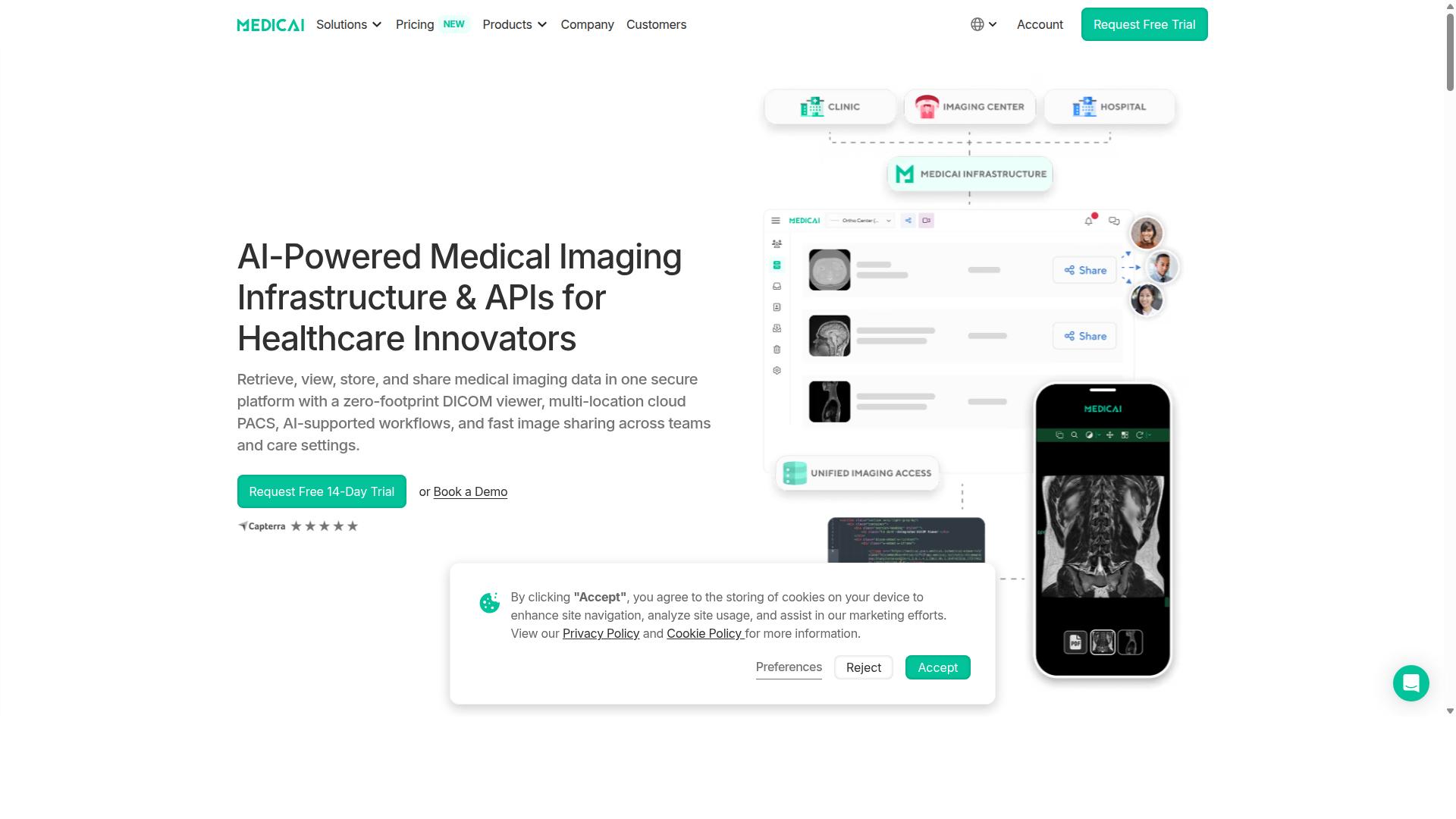
Medicai is a cloud-based medical imaging platform that lets providers retrieve, view, store, and share imaging data through a zero-footprint DICOM viewer.
The platform works as Imaging Infrastructure as a Service and supports multi-location cloud PACS deployments. Healthcare teams can use it in any care setting without installing local software.
Core capabilities include secure access to medical images, AI-supported workflows, and rapid image sharing between different teams. The system emphasizes interoperability across healthcare organizations.
As a VC-backed healthcare startup, Medicai focuses on updating traditional medical imaging workflows. Organizations gain a single secure environment for their PACS needs.
What Is PostDICOM?
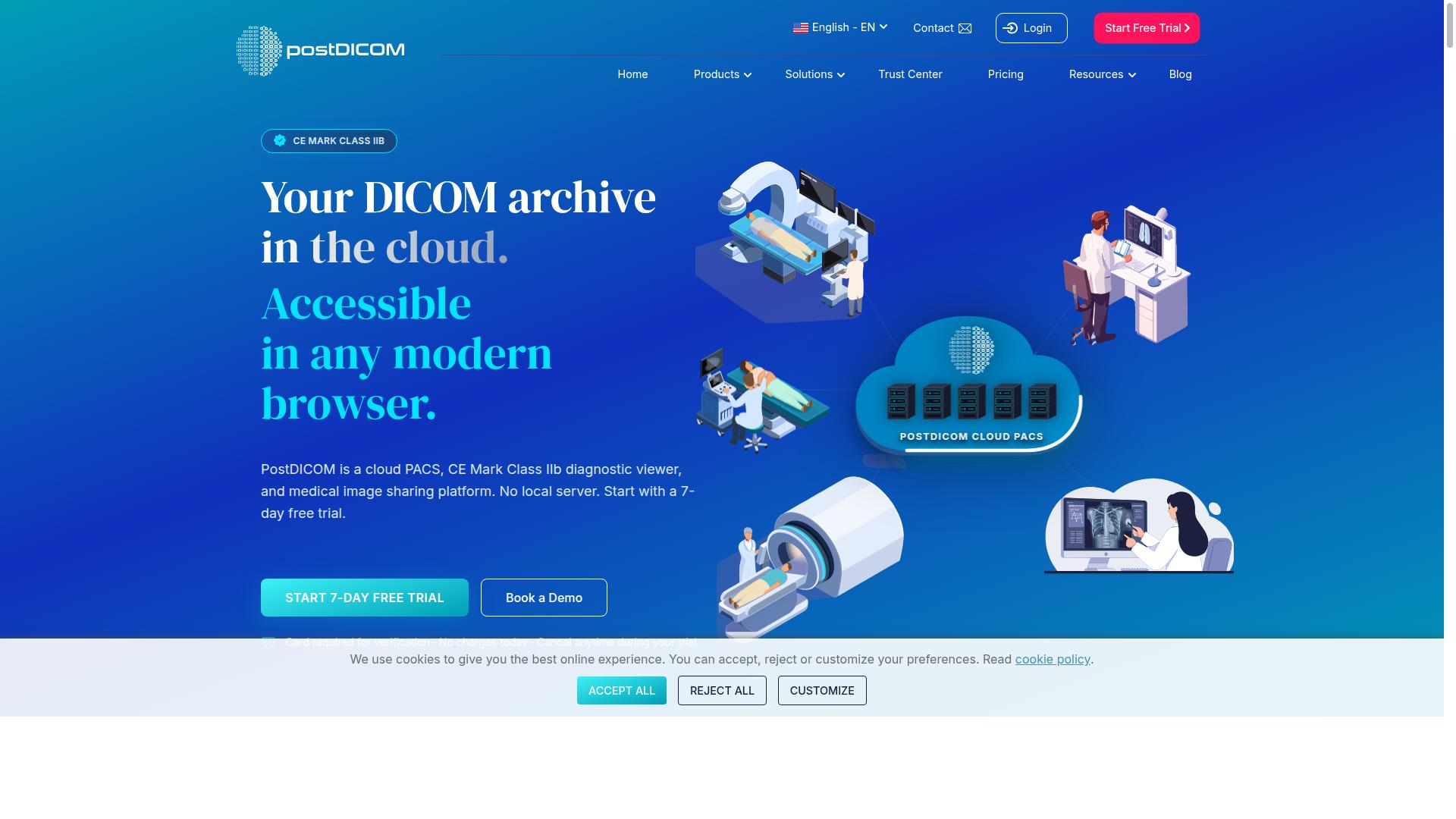
PostDICOM is another cloud-hosted PACS solution that provides storage, viewing, and sharing of medical images for radiology teams. Many healthcare organizations explore this platform when they need flexible cloud PACS options beyond traditional on-site servers.
Users can upload DICOM files, access a web viewer, and retrieve studies from different locations. The service supports multi-modality imaging and offers basic annotation tools that help radiologists review cases efficiently.
PostDICOM operates through a subscription model that includes cloud storage, image archive capabilities, and secure access. Research suggests these types of platforms often emphasize HIPAA compliance and data security measures like encryption to protect patient information during transmission and storage.
Teams that choose cloud PACS solutions like this one typically look for reliable uptime, good upload speed, and integration options with existing EHR systems. Some practices also value mobile access for remote reading and teleradiology workflows.
What Is Medicai for Cloud PACS?
Within Medicai's platform, the Cloud PACS module handles upload, storage, and retrieval of DICOM studies at scale. The system connects radiology centers, hospitals, and clinics through a dedicated uploader and DICOM gateway.
Once data reaches the cloud, the vendor neutral archive stores every modality in one location. This structure keeps studies organized while supporting multiple departments at once.
Automated disaster recovery runs in the background. The platform replicates files across secure locations to protect against hardware failure or site loss.
Integrations and external tools interact with the archive through Medicai Imaging API. The platform supports 50 M+ yearly API transactions without slowing routine workflows.
Users access studies through the same interface used for teleradiology and tumor board meetings. The web viewer displays multi-modality images on desktop and mobile devices.
Data remains encrypted during transfer and storage. HIPAA compliance is maintained across the entire workflow from upload to long-term retention.
Features Compared
The next three H3 sections compare storage scalability, security posture, and integration capabilities side-by-side.
Each area plays a direct role in daily radiology workflows. Storage capacity determines how long studies remain accessible. Security standards protect patient data across regions. Integration options connect imaging with EHR records and external tools. These criteria help practices evaluate Cloud PACS platforms for long-term use.
Storage & Scalability
Starter and Standard tiers in Medicai start at 500 GB and 2 TB respectively, each supporting unlimited user accounts.
Medicai offers three defined storage tiers. Starter covers 500 GB monthly at 249 dollars. Standard provides 2 TB for 749 dollars. Enterprise scales to custom volumes with multiple site connections. The platform currently stores 1.7 M+ studies and supports 300 k+ visualizations yearly.
PostDICOM describes storage as flexible yet provides fewer published tier limits or uptime commitments. Medicai publishes explicit SLA metrics and scales storage without per-user fees. This structure suits radiology groups that need predictable costs and rapid growth.
Security & Compliance
Medicai is HIPAA and GDPR compliant, FDA/CEE cleared, and processes over 1 M studies per year under those certifications.
Medicai follows OWASP security guidelines and encrypts data in transit and at rest. The platform maintains FDA/CEE cleared viewers and processes over 1 M studies annually under these certifications. Compliance documentation covers both US and EU requirements.
PostDICOM states it meets standard regulatory expectations yet shares fewer explicit compliance details. Medicai publishes its full certification stack and yearly study volume. Radiology teams handling cross-border data benefit from this documented approach.
Integration & API Access
Medicai exposes 50 M+ yearly API transactions and integrates with EHR/EMR systems, Microsoft Azure, AWS, and third-party AI tools.
Medicai connects directly to EHR and EMR systems through its documented API. The platform also links with Microsoft Azure and AWS environments. Third-party AI tools can access imaging data through the same interface. Fifty million API transactions occur each year across active accounts.
PostDICOM offers general integration options without published transaction volumes or partner lists. Medicai provides specific endpoints and partner connections. This transparency helps IT teams plan data flows between Cloud PACS and existing hospital systems.
Pricing Compared
Medicai's monthly plans begin at $249 for 500 GB and $749 for 2 TB, while PostDICOM pricing is not publicly broken out in this review.
Starter gives teams 500 GB of cloud storage and unlimited user accounts with no connected locations. This entry level works well for smaller radiology groups or clinics that review studies internally.
Standard raises storage to 2 TB and adds one connected location. The tier suits practices that need to link a local DICOM gateway to their cloud archive.
Enterprise customers receive custom storage volumes and multiple connected locations. A one-time DICOM Gateway Setup fee of $1,000 applies per location when hardware integration is required.
Yearly billing reduces the monthly rate by 15 percent for both Starter and Standard tiers. No refunds are issued for partial billing periods under any plan.
Medicai offers a 14-day trial of Starter plan features with no credit card required. Per-study pricing remains available for enterprise customers who prefer usage-based billing over fixed subscriptions.
PostDICOM does not publish storage tiers, location limits, or gateway fees in public materials. Without disclosed pricing, teams must request quotes to compare total cost of ownership directly.
Medicai lists every storage amount, user allowance, and location cap up front. This transparent structure helps radiology departments forecast expenses and scale their Cloud PACS usage without hidden fees.
Who Should Choose Medicai
Hospitals, imaging centers, and specialty groups handling high study volumes benefit most from Medicai's scalable Cloud PACS. These organizations often manage thousands of studies monthly and require reliable access across multiple locations. The platform supports diverse medical specialties without additional infrastructure investments.
Specialty care providers in orthopedics, neurology, oncology, cardiology, and ophthalmology find the system particularly valuable. Each discipline benefits from consistent access to imaging data regardless of where studies originate. Multi-modality support ensures that different imaging types remain accessible within a single interface.
Virtual care providers and teleradiology services gain from global availability. Remote teams can review studies from multiple geographic regions without latency concerns. Patient Portal features also allow direct sharing with patients when needed.
Organizations with existing PACS infrastructure should evaluate data migration requirements before switching. Some facilities may prefer gradual transitions rather than complete system replacements. Research suggests that organizations processing high study volumes typically see the greatest efficiency gains from cloud-based solutions.
Who Should Choose PostDICOM
Smaller practices seeking a straightforward Cloud PACS may consider PostDICOM if their study volume remains modest. PostDICOM offers a basic platform for storing and viewing medical imaging studies online. Many facilities appreciate its simple approach when complexity is not required.
Practices that handle limited daily scans often find general cloud solutions adequate for core needs. PostDICOM provides standard DICOM upload and basic web viewer functions. The user interface works for routine radiology tasks without advanced tools.
Some groups prefer a single subscription model that covers storage and access. PostDICOM can serve as an entry point for teams transitioning from local servers. This option suits environments where scalability demands stay low.
Organizations with stable, predictable imaging workloads may review this solution first. PostDICOM focuses on essential image archive functions rather than extensive integrations. Teams managing only occasional teleradiology cases sometimes select such streamlined services.
Users who prioritize simplicity over additional features often explore PostDICOM initially. The platform supports common modalities and basic compliance requirements. Practices that anticipate future growth may evaluate other Cloud PACS options later.
Who Should Choose Medicai for Cloud PACS
Teams needing automated disaster recovery, 3-D reconstruction, and vendor-neutral archive functionality should evaluate Medicai's Cloud PACS module. The platform provides a complete suite of tools that address the requirements of modern medical imaging workflows.
Organizations processing high volumes of studies benefit from proven capacity that handles more than one million studies annually. This scale reflects the system's reliability across diverse medical imaging environments.
Facilities requiring a vendor neutral archive gain a centralized storage solution that eliminates vendor lock-in while maintaining compliance standards. The VNA component supports long-term data preservation across multiple imaging modalities.
Backup and disaster recovery features ensure continuous data protection through automated processes. These capabilities reduce the risk of data loss while supporting uninterrupted clinical operations.
Multi-modality support allows teams to manage studies from CT, MRI, ultrasound, and other imaging sources within a single interface. This unified approach simplifies workflow management for radiology departments handling varied case types.
The 3-D reconstruction tools enable detailed visualization of complex anatomical structures. Clinicians can examine spatial relationships that flat images cannot adequately convey.
These capabilities position Medicai as a strong option for healthcare providers seeking integrated cloud PACS functionality. The combination of archive management, recovery assurance, and visualization tools addresses common infrastructure needs in contemporary radiology practice.
Final Verdict
For teams prioritizing documented HIPAA/GDPR compliance, 50 M+ API transactions, and clear storage tiers, Medicai offers a transparent path to scalable Cloud PACS.
Storage options differ between platforms. PostDICOM presents general cloud storage without published tier breakdowns. Medicai defines distinct tiers with predictable costs as imaging volumes grow.
Compliance documentation sets another distinction. PostDICOM maintains basic security measures. Medicai publishes specific HIPAA and GDPR certifications that legal teams can review directly.
API capacity affects integration planning. PostDICOM does not disclose transaction volumes. Medicai supports over 50 million API calls, enabling reliable connections to existing EHR systems.
Geographic reach matters for multi-site deployments. PostDICOM keeps a limited regional presence. Medicai maintains offices on two continents with dedicated support teams.
Teams evaluating both platforms can contact Medicai directly. The USA office is located at 7901 4th St N, STE 300, St. Petersburg, FL, 33702, reachable at +1 (832) 220 1035. Our breakdown of Top Peptide Companies in the USA 2026 covers the related details.
The Romania office operates at 53-55 N Filipescu, 5th Floor, Sector 2, Bucharest, 020961, reachable at +40 316 305 875. Email inquiries go to [email protected].
Recommended Resources: